


Choosing Fireplace Beams That Feel Made for Home

A fireplace can be perfectly serviceable yet still feel unfinished. Often, the missing element is not another accessory or a change of paint colour, but a solid timber mantel that gives the whole chimney breast purpose. Fireplace beams do this quietly and brilliantly: they add weight, warmth and a natural focal point, whether the room is a Victorian terrace, a renovated cottage or a newer home in need of character.
The best beam should never look as though it has simply been placed above the fire. It should feel settled into the room, with proportions that suit the opening, a colour that belongs alongside the flooring and furniture, and enough presence to hold its own without overwhelming the space. That is why made-to-measure oak is often worth choosing over an off-the-shelf alternative.
Why solid oak fireplace beams make a difference
Oak has an honesty that manufactured finishes struggle to copy. Its grain varies from board to board, with knots, medullary rays and subtle tonal shifts that tell the story of the timber. A solid oak beam is not trying to be uniform. Its character is precisely what makes it such a satisfying part of a home.
There is also a practical reason oak remains a favourite for fireplace mantels. It is dense, durable and substantial, so a correctly fitted beam feels secure and purposeful. It can complement a traditional inglenook, soften the clean lines of a contemporary stove installation or bring a little heritage to a simple plastered chimney breast.
Not every oak beam needs to be deeply rustic. A cleaner, more refined finish can work beautifully in modern country interiors, while saw marks, softened edges and more visible knots create a weathered look with real depth. The right choice depends on the room around it. A heavily distressed beam may suit an old stone cottage, but can feel out of place in a crisp new extension where a lightly finished, straighter-edged mantel would sit more naturally.
Solid timber versus veneered and imitation beams
Veneered, hollow and imitation beams can cost less and may be useful where weight is a concern. However, they rarely offer the same depth at the edges, the same feel under the hand or the freedom to tailor every detail. Their repeated grain patterns can also become apparent over time.
A solid oak mantel is an investment in material rather than an effect. It can be sanded, refreshed and appreciated for decades. Natural movement is part of owning genuine timber, particularly as seasons change, but carefully selected and properly dried oak keeps this to a minimum. Small checks and surface variations are not faults to hide - they are signs of an authentic piece of wood settling into a lived-in home.
Choosing the right size for fireplace beams
Proportion is the first decision to make. A beam that is too short can make the fireplace look narrow and disconnected; one that is too deep or too thick may dominate a modest room. Measuring before ordering is essential, particularly where alcoves, sockets, picture rails or a television affect the available space.
As a starting point, allow the mantel to extend beyond either side of the fireplace opening or chimney breast feature. The amount of overhang is a matter of taste, but it should look deliberate and balanced. In a larger room, a generous length creates a strong horizontal line. In a compact sitting room, a more restrained projection can stop the wall from feeling crowded.
Beam depth - the distance it projects from the wall - matters as much as length. A deeper beam offers more room for a vase, candlesticks or seasonal foliage, but it must not intrude into the room or sit too close to the heat source. Beam height creates its visual weight. A chunky section can anchor a large fireplace beautifully, whereas a slimmer profile may be the better fit above a small wood burner.
It is worth marking out the proposed size with masking tape or a cardboard template before committing. Stand back from the usual seating position, then look at it from the doorway. This simple step often makes the correct proportion obvious.
Allow for the fireplace and heat source
Fireplace beams must be positioned with safety in mind. The required clearance above a stove, open fire or other appliance varies according to the manufacturer’s instructions, the appliance type and the installation itself. Always follow the guidance supplied with the fire or stove, and ask a qualified installer when there is any doubt.
Oak is a natural combustible material, so it should never be treated as a decorative afterthought. Plan its position early, especially during a renovation, rather than trying to squeeze a mantel into a finished fireplace surround. A well-planned gap can preserve both the look of the beam and the safe operation of the appliance.
Selecting a finish that belongs in your room
The finish shapes how the oak will read in the space. Bare or lightly oiled oak keeps the appearance fresh and natural, allowing honeyed tones and grain to remain visible. A medium oak finish often works well with older furniture, warm neutral walls and traditional flooring. Darker finishes bring contrast and drama, particularly against pale plaster, though they can make a small chimney breast feel heavier.
Colour matching is valuable when the beam needs to sit alongside existing oak flooring, doors or furniture. Exact matches are rarely possible because every piece of timber absorbs finish differently, but a considered sample and a sympathetic tone can make the relationship feel intentional rather than accidental.
Think about light as well as colour. North-facing rooms can make oak appear cooler, while strong afternoon sun often brings out golden undertones. If the room is still being decorated, choose the mantel with wall colour, flooring and the hearth material in mind. A beam is usually installed for the long term, so it makes sense to select a finish that will outlast a passing paint trend.
The details that make a handcrafted beam feel personal
The edge treatment and surface texture are small choices with a noticeable effect. Softly eased edges are comfortable and timeless, with enough refinement for most homes. A more irregular edge can make a mantel feel older and more rustic. Hand-finished saw marks add texture, while a smoother finish puts the focus on the grain.
At Country and Coast, each oak beam is made individually in our Llandudno workshop rather than taken from a generic warehouse shelf. This allows the length, section size, finish and character to be considered together. Sustainably sourced certified oak is selected for its individual markings, because a mantel should have a character of its own, not the identical appearance of every other one.
That individuality also means embracing variation. Knots may be filled, left more visible or placed where they add interest without distracting from the overall balance. Grain can run boldly through the face or appear quieter and more linear. A good maker will explain what is realistic for the timber and help you choose a finish that enhances rather than disguises it.
Fitting a beam with confidence
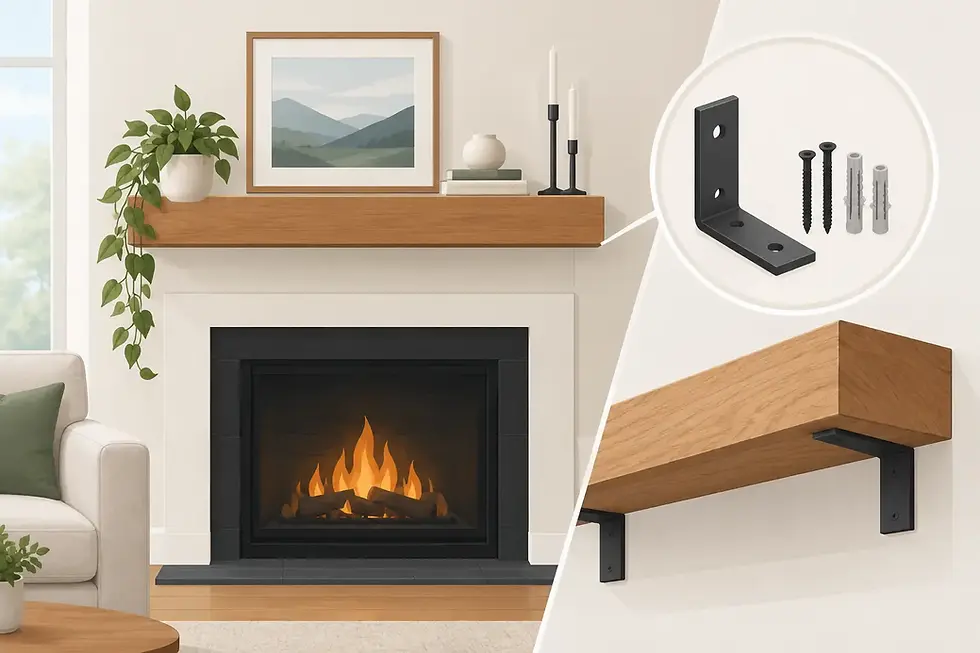
A substantial oak mantel needs secure, appropriate fixings. The wall construction matters: solid brick, blockwork, stone, plasterboard and timber-frame walls each require a different approach. Hidden fixings give the clean floating appearance many homeowners want, but they must be properly supported by sound masonry or suitable structural backing.
Pre-drilled fittings make installation more straightforward, yet careful measuring remains essential. Check the level, mark the intended height clearly and confirm the beam sits where it should before drilling into the wall. For particularly heavy beams, uneven stonework or unfamiliar wall construction, using an experienced fitter is a sensible choice. The finished result is only as good as the fixing behind it.
Avoid loading the mantel immediately with very heavy objects. Once fitted, a few well-chosen pieces are usually enough: a framed family photograph, a ceramic vessel or a pair of candlesticks can bring the beam to life without turning it into storage. Let the oak remain visible. It is the feature you chose for the room.
A fireplace beam earns its place through more than measurements and fittings. It becomes the ledge where birthday cards gather, where winter greenery appears, and where the eye rests at the end of a long day. Choose one with care, and it will make the room feel more like yours from the moment it is fitted.


Comments