


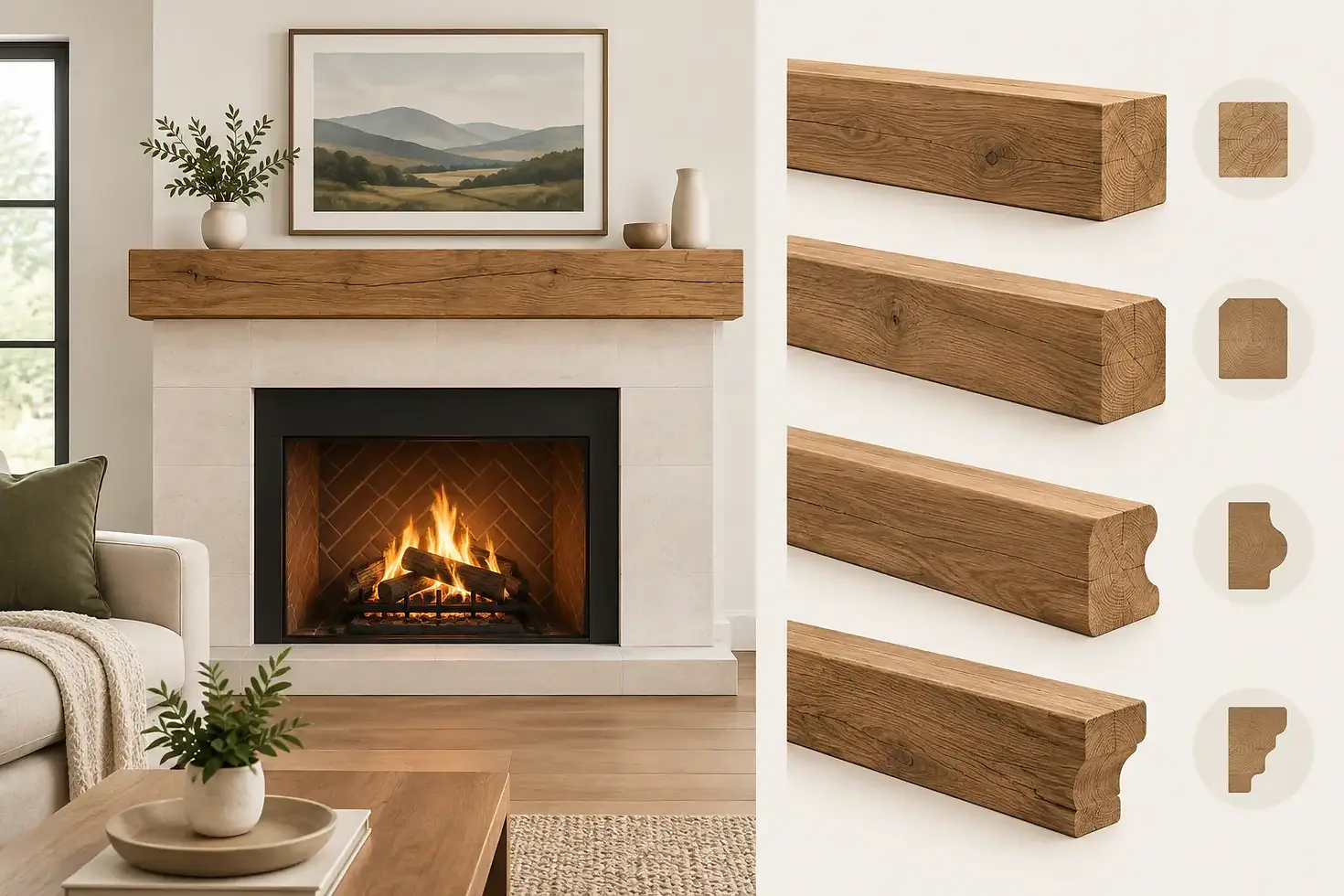
Best Oak Beam Profiles for Your Fireplace

A fireplace beam can look beautifully made yet still feel wrong if its profile does not suit the room. The best oak beam profiles balance the scale of the fireplace, the age and character of the property, and the finish of the surrounding space. A deep, heavily textured beam can bring presence to a large inglenook, while a cleaner, more restrained profile may be the better choice for a newer home or a narrow chimney breast.
Because every solid oak beam has its own grain, knots and tonal variation, the profile is not simply a decorative detail. It determines how the beam catches the light, how substantial it appears from across the room, and whether it feels traditionally rustic, quietly contemporary or somewhere in between.
What does an oak beam profile mean?
The profile is the shape and treatment of the visible faces and edges of a mantel beam. It includes the beam's depth and height, whether the edges are square or softened, how much natural texture is retained, and the way the ends are finished.
Two beams can share exactly the same length but create very different results. A crisp square-edged oak shelf gives a tailored, architectural line. A beam with gently eased edges, visible saw marks and hand-worked detail feels warmer and more established. Neither is automatically better. The right choice comes down to the room, the fireplace opening and the character you want the mantel to bring.
At Country and Coast, each oak beam is made to order rather than selected from standard stock. That matters when choosing a profile, because it allows the dimensions, edge detail and finish to work together rather than asking your home to fit a generic product.
The best oak beam profiles for different interiors
Square-edge profiles for a clean, confident look
A square-edge profile has straight, defined lines along the front and underside of the beam. It is a strong choice for homes with simple joinery, contemporary stoves, plastered chimney breasts and modern country interiors. The profile allows the oak itself to do the talking, putting the focus on the grain and natural colour rather than heavily distressed surface detail.
Square edges suit a beam with a generous section particularly well. A substantial 150 mm or 200 mm deep beam can look purposeful and refined when its lines are clean. In a smaller room, however, that same depth may feel dominant. A slimmer section with square edges often gives enough presence without crowding the wall.
This is also a practical option if you favour a neat, less rustic finish. It still has the variation and warmth that only real oak can offer, but it does not try to imitate an old reclaimed timber.
Softened-edge profiles for everyday warmth
Softened or eased edges are gently rounded to remove the sharpness from a square profile. It is a subtle treatment, but it changes the feel of the mantel considerably. The beam appears more tactile and relaxed, and it sits comfortably in both traditional and newer homes.
For many fireplaces, this is the most versatile profile. It has enough refinement to complement painted walls, fitted cabinetry and a contemporary stove, but enough softness to sit naturally beside stone, brick or lime plaster. It is especially well suited to family living spaces, where the fireplace is used as a true focal point rather than a formal display.
A softened edge should not mean an overly rounded, manufactured appearance. On a handcrafted solid oak beam, the aim is to preserve the timber's honest character while creating an edge that feels considered and comfortable.
Hand-finished rustic profiles for period character
If your home has an older stone fireplace, exposed brickwork, low ceilings or original timber details, a more textured, hand-finished profile can be the natural fit. This style may retain more of the oak's knots, undulation, saw marks and surface interest, with edges that are gently worked rather than perfectly uniform.
The appeal is not that the beam looks artificially aged. It is that it has a depth of character which sits easily in a room with history. Natural movement, grain changes and small imperfections are part of what makes a solid oak mantel feel individual.
There is a trade-off. A strongly rustic profile can feel out of place in a very minimal room with sleek materials and sharp lines. It works best when there is another element nearby to echo its warmth, such as a flagstone hearth, a timber floor, a woven wool rug or aged metal accessories.
Live-edge details for a one-of-a-kind feature
A live-edge or waney-edge detail follows some of the oak's natural outer contour rather than cutting every face to a straight line. Used with care, it can make a fireplace beam feel truly individual. Each piece will be different, and the edge brings a softer, organic quality to the room.
This profile is often best used selectively. A full live edge can be a striking choice for a country cottage or a relaxed, nature-led interior, while a lightly retained natural edge may suit a more polished space. It depends on how much movement and visual texture is already present around the fireplace.
For a long mantel, a pronounced live edge can become the feature in its own right. For a compact fireplace, a quieter profile may keep the proportions more balanced.
Choosing the right beam proportions
Profile and size must be considered together. A beautifully finished beam will not look right if it is too thin for a wide chimney breast or so deep that it overhangs the fireplace awkwardly.
As a starting point, allow the beam to extend beyond each side of the fireplace opening so it feels anchored to the wall rather than perched above the stove. The exact overhang depends on the width of the chimney breast and what sits beneath it, but visual balance is more useful than a fixed rule. A broad inglenook can carry a longer, deeper beam. A modest opening often benefits from a simpler section and a more restrained projection.
Depth has a strong effect on the finished look. A deeper beam creates shadow beneath the mantel and makes the fireplace feel more substantial. It can also provide useful display space for a vase, seasonal greenery or a few carefully chosen pieces. A shallower profile keeps the room feeling open and is often the sensible choice where walkways are tight.
Height affects visual weight. A taller front face has a traditional, generous appearance, particularly above a large opening. A lower-height beam with a clean profile feels lighter and more contemporary. If you are uncertain, consider the other horizontal lines in the room, such as window sills, shelving and kitchen worktops. The mantel should feel related to them, not accidentally oversized.
Match the finish to the profile
The finish can either emphasise the profile or soften it. A pale natural finish brings out fresh oak tones and works particularly well with square or eased edges in bright rooms. A medium warm oak finish gives added depth and can help a beam sit comfortably alongside older flooring or furniture.
Darker finishes tend to suit more substantial beams and traditional settings, where they create contrast against a pale chimney breast. They can look handsome, but they also make a beam appear visually heavier. In a compact room with limited natural light, a lighter finish may show the grain more clearly and keep the fireplace from feeling too imposing.
Colour matching is worth discussing if the room already contains oak doors, flooring or furniture. Exact matching is rarely realistic because every piece of timber takes colour differently, but a carefully chosen tone can make the mantel feel intentionally connected to the rest of the space.
Do not overlook the beam ends and fittings
The visible ends of an oak beam are part of its profile, especially when the mantel projects beyond a chimney breast or is fitted as a floating shelf. A clean-cut end looks crisp and simple. A hand-finished end has more texture and makes the beam feel less formal. Where the beam meets a side wall, this detail is less visible, but it still influences the overall craftsmanship.
Installation should be planned before the beam is made. Solid oak is substantial, and the wall construction, beam weight and fireplace clearances all need proper consideration. A made-to-measure mantel with pre-drilled fittings takes much of the uncertainty out of fitting, but the chosen profile should still allow enough depth for secure fixing and suitable projection from the wall.
If the beam is to sit above a stove, always follow the stove manufacturer's clearance guidance. The most attractive profile is only the right one when it is also safely positioned.
A profile that belongs in your home
The best choice is rarely the most distressed beam or the cleanest-cut one in isolation. It is the profile that looks as though it has always belonged above your fireplace. Look at the room's materials, measure the chimney breast carefully, and choose a beam that gives the space warmth without overwhelming it.
A handcrafted oak mantel earns its place slowly. As the light changes through the day and the grain becomes familiar, it becomes more than a shelf above the fire. It becomes part of the home’s own character.


Comments